ITIL (Information Technology Infrastructure Library) is a set of best practices for IT service management. Often searched as the ITIL framework, ITIL processes, or the Information Technology Infrastructure Library, it helps organizations structure their operations, improve service quality, and better align IT with business needs.

The ITIL process can be understood as a reference framework that brings together best practices to support effective IT service management, optimize the use of technology, and deliver better service to users.
Over time, ITIL has become an international reference point for organizations that want to standardize their processes, improve collaboration, and strengthen operational performance.
For IT teams, ITIL is especially useful when it comes to tracking assets, software, licenses, and the day-to-day activities involved in IT asset management.
The major Versions of ITIL
Since its creation, ITIL has evolved to keep pace with technological and organizational changes. Understanding the major versions of ITIL helps explain how the ITIL framework and ITIL processes have developed over time.
Here is a table comparing the evolution of ITIL versions:
| Version | What to remember |
|---|---|
| ITIL v1 | The first structured set of best practices designed to improve IT support and service quality. |
| ITIL v2 | A more formal process-based version, with a stronger focus on support, help desks, security, and some aspects of asset management. |
| ITIL v3 | Introduced the service lifecycle approach, with five major stages: service strategy, service design, service transition, service operation, and continual service improvement. |
| ITIL 4 / ITIL v4 | A more modern approach focused on value creation, collaboration, agility, automation, and continual improvement. |
Historically, ITIL went through four major versions: v1, v2, v3, and ITIL 4. Today, the framework continues to evolve with ITIL (Version 5), which PeopleCert is introducing progressively.
ITIL 4: Dimensions and Guiding Principles
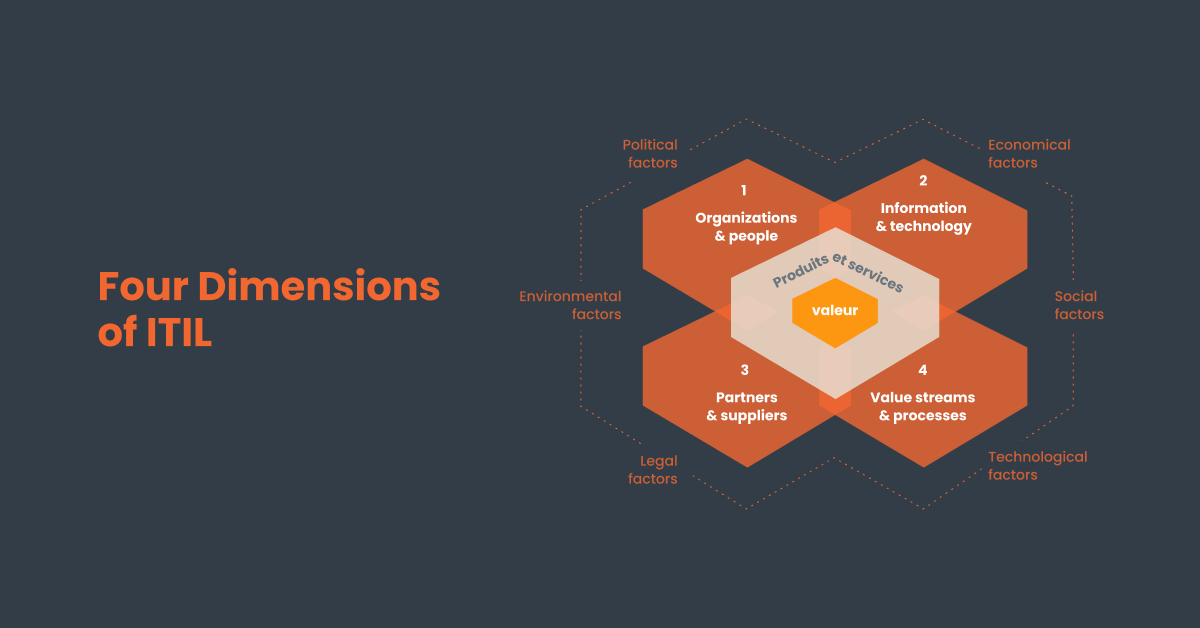
The 4 Dimensions of ITIL
ITIL emphasizes value creation, adapting to change, collaboration among teams, and continuous improvement.
It helps organizations make better use of information technology, standardize their ITIL processes, and deliver more consistent services.
ITIL is thus based on these four dimensions of service management:
- Organizations and People
- Information and Technology
- Partners and Suppliers
- Value Streams and Processes
The 7 Guiding Principles of ITIL
ITIL also relies on 7 guiding principles that help organizations make better decisions, improve services, and evolve their practices in a realistic way.
- Focus on value
- Start where you are
- Progress iteratively with feedback
- Collaborate and promote visibility
- Think and work holistically
- Keep it simple and practical
- Optimize and automate
These ITIL principles are especially useful for teams that want to improve the way they work without starting from scratch, while keeping a clear framework for IT service management.
What are the Benefits of ITIL for an Organization?
ITIL helps organizations:
- be tter structure their ITIL processes
- improve IT service management
- support digital transformation
- encourage collaboration across teams
- promote automation of repetitive tasks
- adapt more quickly to change
- improve the quality of service delivered to users
- reduce errors, wasted time, and some long-term costs
In practice, ITIL also helps organizations better manage documentation, asset tracking, internal requests, incidents, and the flow of information across IT teams.
Moving Toward ITIL Version 5
The transition from ITIL 4 to ITIL (Version 5) follows a logic of continuity. In other words, ITIL 5 does not discard the foundations of ITIL 4. It builds on them to better reflect today’s digital, product-centric, and AI-enabled environments.
PeopleCert also makes it clear that this is not a reset: existing ITIL knowledge, experience, and certifications remain relevant, and the transition is being rolled out progressively.
ITIL 4 and ITIL 5: What are the Main Differences?
Since its inception, ITIL has evolved to address new technological and organizational realities. Understanding the different versions of ITIL provides a clearer picture of how ITIL processes and service management best practices have evolved.
Here is a table comparing the changes across the different versions of ITIL:
| Criteria | ITIL 4 | ITIL (Version 5) |
|---|---|---|
| General positioning | Modern service management framework. | Evolution toward digital product and service management. |
| Main logic | Focus on service quality and value creation. | Focus on end-to-end value, with a broader and more current perspective. |
| Operational view | Structures services with the Service Value System, the Service Value Chain, the 4 dimensions, and the guiding principles. | Builds on that base while reinforcing value streams, experience, governance, and broader lifecycle management. |
| AI and modernity | Modernized version, open to more agile ways of working. | More explicitly integrates AI-enabled environments and current digital realities. |
| Practices | Built around ITIL 4 practices. | Keeps the core logic, with stronger emphasis on product and service management across the lifecycle. |
| Transition | Still relevant and still used by many organizations. | Progressive rollout, positioned as an evolution rather than a rupture. |
| Certification | ITIL 4 Foundation remains known and available. | The official entry point is now ITIL Foundation (Version 5). |
While ITIL 4 modernized service management around the Service Value System, the Service Value Chain, the four dimensions, and the guiding principles, ITIL (Version 5) takes this approach further by placing greater emphasis on the management of digital products and services, end-to-end value creation, customer experience, governance, value streams, and AI-enabled contexts.
In practice, ITIL 5 offers a more up-to-date perspective on operations: it helps organizations better align strategy, execution, cross-team collaboration, and continuous improvement, while more clearly integrating issues related to automation, AI, and the full lifecycle of digital products and services.
ITIL and IT Asset Management
ITIL is not just a theoretical framework. In practice, it helps organizations better structure the management of services, requests, incidents, and the lifecycle of IT assets.
When an organization wants to apply best practices on a daily basis, it needs to be able to track its IT environment, equipment, software and licenses, and inventory movements with accuracy. That is where a tool like Hector becomes relevant: it helps turn processes into concrete, traceable, and measurable actions.
For example, a team can apply ITIL best practices more effectively when it has:
- a clear view of its IT environment
- an up-to-date inventory
- lifecycle tracking for assets and software
- automated reminders, reports, and a reliable history
ITIL Certification
As is the case with ISO certifications, a company must hold ITIL certification to be considered an organization that goes to great lengths to provide quality services and products to its customers.
Above all, ITIL certification allows professionals and teams to formalize their understanding of the framework and adopt a common language in IT service management, much like ISO certifications, which play a similar role in other areas of business management.
The journey typically begins with ITIL Foundation (certified by PeopleCert), which serves as an introduction to key concepts, terminology, and practices. From there, other paths allow for further specialization based on roles and needs.
Thus, to obtain ITIL certification, an organization must complete an accredited training course (ITIL 4 Foundation Certification).
Why ITIL is Useful for my Organization
Adopting ITIL helps bring structure to IT service management. The framework supports a common language, clearer responsibilities, better-quality processes, and more centralized information.
For organizations that manage an IT environment, software, licenses, and equipment, ITIL becomes even more useful when it is supported by a tool that can track assets, document their lifecycle, and support day-to-day operations.
In short, ITIL provides the framework, and a tool like Hector helps put it into practice.
Hector at the service of your IT processes
Structure and centralize the management of your equipment, software, licenses, and inventory with a simple and effective solution in one tool.
FAQ – All questions we hear about ITIL
Is ITIL 4 still up to date?
Yes, ITIL 4 remains current in practice and is still widely used. Released in 2019, it modernized the framework by bringing in more agile and collaborative ways of working. However, it is no longer the newest official evolution of the framework: ITIL continues to evolve with ITIL (Version 5), while ITIL 4 remains relevant and useful for many organizations.
Is ITIL certification worth it?
Yes, ITIL certification can be worth it, especially for professionals working in IT service management, IT operations, transformation, or support. PeopleCert positions ITIL Foundation (Version 5) as an industry-recognized certification, an entry point into ITIL, and a way to build in-demand skills for digital product and service management. Its value is strongest when your organization already works with ITIL practices or when you want to grow in structured ITSM environments.
Is ITIL a standard?
The term “ITIL standard” is often used, but ITIL is primarily a best-practice framework. It is better described as a structured reference framework for service management and digital product and service management than as a formal standard in the strict sense.