

Inventory planning is essential for any organization that needs to track supplies, equipment, and materials efficiently. Schools, construction companies, IT departments, and other industries must manage inventory effectively to avoid shortages, optimize stock levels, and reduce costs. A well-structured inventory management plan ensures that essential resources are available when needed while preventing unnecessary expenditures and delays.
Organizations that depend on inventory for daily operations—whether managing classroom supplies, construction materials, IT hardware, or facility maintenance equipment—benefit from a strategic approach to inventory planning. By leveraging data management tools, automation, and an inventory management system, businesses and institutions can improve operational efficiency and sustainability. Additionally, inventory management software enhances tracking, reduces holding costs, and supports supply chain management.
5 Benefits of Inventory Planning for Your Organization
Inefficient inventory planning can result in wasted resources, project delays, and increased operational costs. Whether tracking textbooks, IT assets, safety gear, or construction materials, organizations must implement robust inventory control strategies. Some key benefits include:
1. Increased Transparency and Control
Inventory planning enhances visibility into current inventory, preventing misplaced, lost, or stolen items. With real-time tracking tools, organizations can maintain accountability, reduce errors, and improve overall stock management. Proper inventory control helps maintain optimal stock levels and ensures compliance with quality assurance measures.
2. Optimized Resource Allocation
Resource allocation is critical for many organizations. Tracking usage trends and forecasting demand ensures that materials, tools, and equipment are available when needed, reducing disruptions in operations. Demand forecasting based on historical data and sales data helps organizations meet demand effectively.
3. Cost Savings and Efficient Budgeting
Proper inventory management minimizes unnecessary expenditures by reducing overstocking and stockouts. Schools can allocate budgets more effectively, IT teams can manage hardware replacements efficiently, and construction companies can control procurement costs. Effective inventory turnover strategies improve cash flow and reduce excess inventory costs.
4. Improved Quality Control and Compliance
Regular inventory checks help organizations monitor the condition and usability of assets. Ensuring compliance with safety regulations, environmental standards, and industry-specific requirements is crucial for businesses of all types. Quality control measures ensure that items meet required standards before deployment. You can also plan your maintenance management and apply corrective action when needed.
5. Streamlined Procurement and Replenishment
Having a replenishment plan ensures timely restocking of essential supplies. Track stationery and educational tools, hardware lifecycles, and raw material deliveries to avoid project delays. Seasonality has to be taken into account. Automation and inventory management software can track reorder points and lead time to ensure efficient order fulfillment.
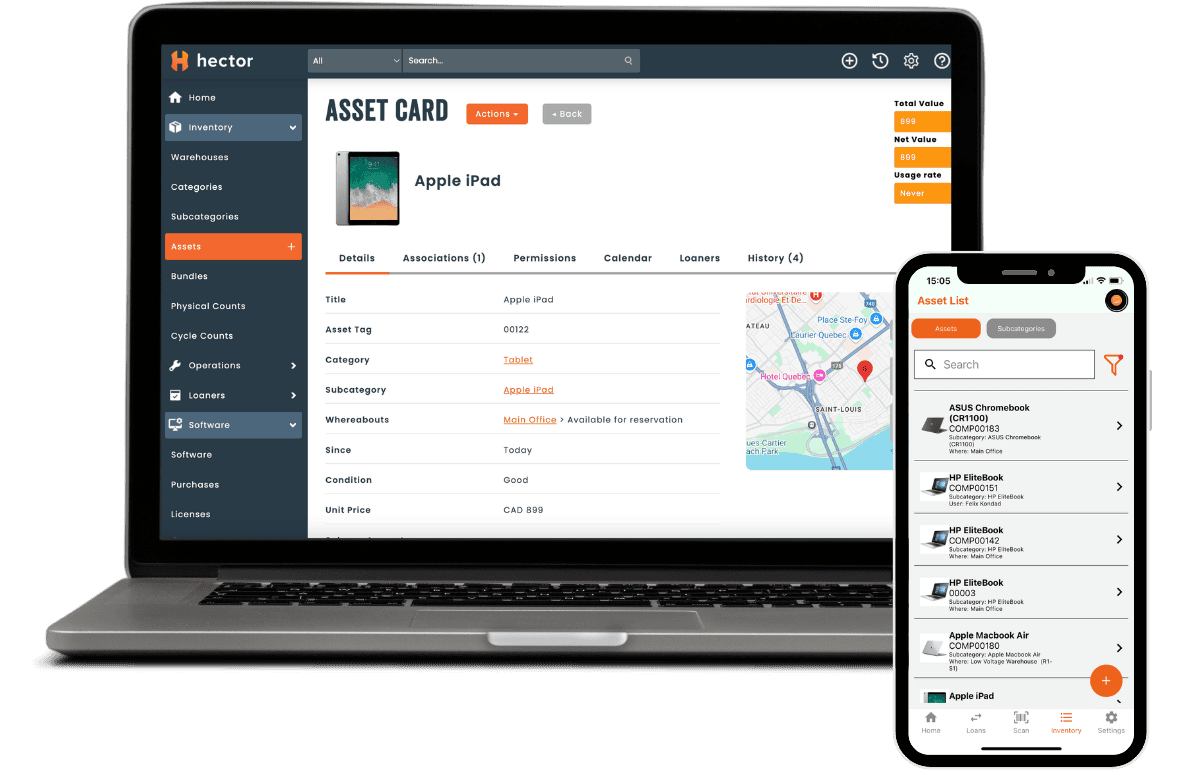
Leveraging Inventory Management Software
Organizations benefit significantly from inventory management software, which streamlines inventory control and tracking processes. Using excel spreadsheets can help to an extent, but a good inventory management plan needs an all-in-one inventory software.
Key features include:
- Automation: Reduces manual tracking errors and improves efficiency by tracking data sources directly.
- Real-Time Notifications: Alerts for low stock levels, reorder points, and equipment maintenance.
- Data Management dashboard: Centralized access to inventory data for better decision-making. See at a glance the amount of inventory you have for each item, their SKU, and other key metrics for your needs.
- Asset Tracking: Barcode and RFID scanning to monitor equipment and stock movements.
- Procurement Integration: Synchronizes purchase orders with inventory levels.
4 Steps to Developing an Effective Inventory Plan
A strong inventory management plan ensures that essential resources are available when needed. Here are four key steps to achieve efficient inventory planning:
1. Demand Forecasting and Inventory Analysis
Organizations must analyze historical data, project needs, and seasonal fluctuations to predict demand. Schools can anticipate supply needs based on enrollment, IT teams track device lifecycles, and construction companies forecast material consumption based on project timelines. Using economic order quantity (EOQ) calculations can help optimize procurement decisions.
2. Implementing a Replenishment Strategy
A well-structured replenishment plan prevents shortages and excess inventory. Establishing reorder points based on lead time, holding costs, and demand fluctuations ensures smooth operations.
3. Inventory Tracking and Optimization
Using inventory management software and barcode tracking enables efficient monitoring of stock levels. Real-time data helps organizations adjust procurement strategies, reducing unnecessary storage costs. Implementing correct data collection methods ensures that inventory turnover rates are accurately measured and optimized.
4. Continuous Monitoring and Adaptation
Regular inventory audits and emissions quantification help organizations track inventory performance and environmental impact. Monitoring trends in usage and adjusting procurement plans help businesses meet customer demand and prevent resource wastage. Outsourcing inventory management functions to specialized providers can further optimize supply chain efficiency.
Inventory Management Methods
Economic Order Quantity (EOQ)
EOQ helps organizations determine the ideal inventory quantity to order while minimizing holding costs. Businesses can calculate EOQ based on procurement costs and lead time to avoid unnecessary stock accumulation.
EOQ formula:
EOQ = √2DS/H
Here’s how to calculate EOQ step-by-step:
- Multiply your total annual demand by the cost to place one order
→ Take the number of units you sell in a year (D) and multiply it by the cost of placing one order (S).
→ Example: If you sell 10,000 units per year and it costs $50 to place an order:
10,000 × 50 = 500,000 - Multiply this by 2
→ 500,000 × 2 = 1,000,000 - Divide by the cost to hold one unit for a year
→ If it costs $2 per unit per year to store inventory (H):
1,000,000 ÷ 2 = 500,000 - Take the square root of this number
→ √500,000 ≈ 707
This means the most cost-effective way to order inventory is in batches of 707 units at a time.
ABC Analysis
This method prioritizes inventory based on value and consumption, helping organizations focus on high-priority assets.
- A items: High-value IT hardware, essential construction tools.
- B items: Secondary office equipment, frequently used materials.
- C items: Low-cost consumables like pens, cables, and safety gear.
How to Perform ABC Analysis
- List all inventory items with their annual usage value (cost per unit × annual demand).
- Sort items in descending order by annual usage value.
- Calculate each item’s percentage contribution to total inventory value.
- Categorize items based on value:
- A items (Top ~20%) → These contribute to ~70-80% of inventory value. Tightly controlled, frequent reordering.
- B items (Middle ~30%) → These contribute to ~15-25% of inventory value. Moderate control.
- C items (Bottom ~50%) → These contribute to ~5-10% of inventory value. Less frequent monitoring, bulk orders.
Example Calculation
Let’s say your total inventory value is $100,000.
- A items: Top 20% of items contribute $80,000 (high-value, strict control).
- B items: Next 30% contribute $15,000 (moderate-value, balanced control).
- C items: Bottom 50% contribute $5,000 (low-value, less attention needed).
Why Use ABC Analysis?
- Focus on critical inventory (A-items)
- Reduce carrying costs (by ordering C-items in bulk)
- Improve stock availability for high-priority items
Just-in-Time (JIT) Inventory
JIT inventory management ensures that supplies arrive exactly when needed, reducing storage costs. This method is useful for construction projects requiring on-demand materials and IT departments managing short product lifecycles. However, JIT requires robust inventory tracking and accurate demand forecasting to avoid shortages.
Just-in-Time (JIT) Inventory is a strategy where you order and receive stock only when it’s needed, rather than keeping large amounts of inventory on hand. This helps reduce storage costs and waste.
How JIT Works
Instead of stocking up, you only order products when customers need them or when production requires them.
Key Steps in JIT Inventory Management
- Forecast Demand Accurately – Predict how much stock you’ll need based on sales trends.
- Work with Reliable Suppliers – Ensure quick deliveries to avoid stockouts.
- Reduce Lead Times – Streamline your supply chain so inventory arrives just in time.
- Keep Safety Stock Minimal – Store only a small buffer of essential items.
Example of JIT in Action
- A car manufacturer using JIT orders parts only when an order is placed.
- A restaurant orders fresh ingredients daily instead of keeping a large stock. Which can improve customer satisfaction as well.
Benefits of JIT
- Lower storage costs – Less money spent on warehousing.
- Less waste – Reduces expired or obsolete inventory.
- More cash flow – Money isn’t tied up in stock.
Challenges of JIT
- Risk of stockouts – If a supplier delays, you might run out of stock.
- Needs strong supplier relationships – Quick and reliable deliveries are crucial.
JIT is ideal for businesses with predictable demand and reliable suppliers.
Conclusion
Efficient inventory planning is crucial for all types of organizations. Implementing an effective inventory management system minimizes waste, optimizes resource allocation, and enhances operational efficiency. By leveraging automation, data-driven forecasting, and real-time tracking, organizations can streamline their inventory planning processes.
Investing in the right management tools ensures seamless procurement, and improves budget control.
